
Last week, AGL Energy announced exciting new plans to develop what it describes as “the world’s largest battery storage ‘virtual power plant” in South Australia.
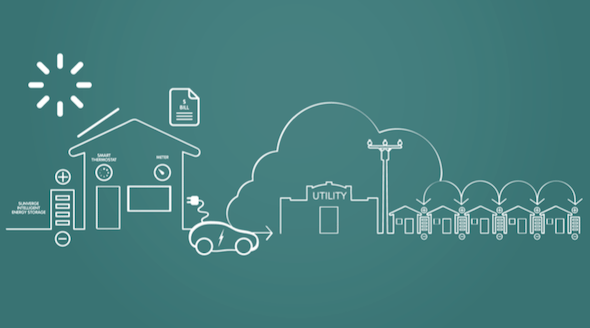
The project will comprise a centrally controlled network of 1,000 residential and business battery storage systems with a combined total of 7MWh capacity – the equivalent of a 5MW solar power plant – that will both store rooftop solar power and help manage network stability in the state.

As we reported, the scheme will have benefits for the grid, which in South Australia is facing the multi-pronged challenge of integrating the nation’s highest penetration of wind and rooftop solar energy into an outmoded, centralised and non-competitive market.
For AGL, it is a giant leap into the distributed energy future, with the opportunity to test, and even control, how distributed energy can be used to create more value for the utility.
But what’s in it for the consumer? According to AGL’s dedicated website, households participating in the project will be able to use more of the energy produced by their solar systems, thus further reducing their energy bills, and will also be able to “enjoy” battery storage “for a fraction of its usual price.”
For the first 150 homes to take part in the scheme, this means they will get a 7.7kWh Sunverge SIS lithium-ion battery and 5kW inverter fully installed at a discounted cost of $3,499.
But we thought we would ask Sunverge, the US-based company that is also supplying the software, or the brains, of AGL’s Virtual Power Plant, what it will mean for consumers – both the households that participate in the scheme and the rest of us, watching on.
“So (in this project) the technology is all about enabling that customer to maximise the use of their PV system – both energy production and consumption,” said Sunverge general manager for Australia and New Zealand, Phil Keogan, over the phone on Tuesday.
“You’re sort of flying blind as to the performance of that system if you’re not monitoring it. What is the PV output? How is that interacting with the load of the house? Are there issues with the battery that are unseen? What’s the temperature of the battery? None of that customer-centric information is available.
“Through the software layer for the customer, we’re able to optimise the use of a (solar and battery storage) system based on a number of factors, like tariff, size of PV system, usage patterns, etcetera.

“We’re consistently monitoring the performance of that service. We monitor it on a moment by moment basis – we poll it every 12 seconds.
“If there was a situation where the battery was overheating, we would shut it down,” he said. “That could be followed by a site visit, but mostly we resolve any issues before the customer is even aware of them.”
But Keogan says that the benefits for consumers go beyond keeping close tabs on their solar and battery systems, to make sure they are running safely and efficiently.
“A lot of batteries are being deployed that are not connected, not being managed and not being monitored,” Keogan said. “At kind of a basic level, having that monitoring functionality is an important part of the technology, to get the best out of that system, for that particular household in that particular area.”
The next step, he adds, is to integrate those systems into the network with a partner, like AGL, thus providing a benefit back to the customer.
Step three is to create network value through these controlled distributed resources that flows back to customers, through such things as capital deferral.
“Where we’re different maybe on a couple of fronts is we have developed hardware with software,” Keogan said of Sunverge. “That’s given us a deeper appreciation of both, and that’s now allowed us to start to extend the software capability to third-party hardware – integrating with other storage devices.
“We are capturing a lot of information at a network layer which could be very valuable in terms of better planning assets, understanding what’s going on in the grid. There’s a lot of potential to leverage that value.
“The technology is done – it’s proven, it’s being used at various places around the world. This (project) is about proving at a network scale that this is a safe, robust, reliable network option and proving to energy markets that this is a reliable source of energy into the NEM.”
Once that is done, Keogan says, there will be no going back to the old way of doing business for utilities.
“We’ll get through this next wave and everything will be properly connected and managed and monitored, and the customer will have the peace of mind of knowing everything is running at optimum level.
“When we’re over that step, that really will drive and influence the regulator, drive and influence the energy market and participants. It’s the right move right now to really move things forward.”

Sophie is editor of One Step Off The Grid and editor of its sister site, Renew Economy. Sophie has been writing about clean energy for more than a decade.