
The extraordinary growth in the uptake of home batteries has slowed a little in October, new data has revealed, as the boom sparked by the federal rebate since its launch in July is tempered by limited installer numbers.
The latest monthly report from SunWiz on Australia’s market for small-scale energy storage systems shows the national market grew by 17 per cent in October, with 736 megawatt-hours (MWh) of new capacity registered.
This is a significant dint in growth compared to 55 per cent charted over the month of September, and gels with the message from the Clean Energy Regulator (CER) last week that the industry is struggling to keep up with demand.
“The capacity of our industry is just about full,” the executive general manager of the CER’s scheme operations division, Carl Binning, told the 2025 All-Energy Australia conference in Melbourne last Wednesday.
“We’re starting to see an increased backlog in orders,” he added. “Wait times are at least three months.”
SunWiz managing director Warwick Johnston says these short-term constraints in deployment have seen growth primarily driven by an increase in the installation of larger capacity systems, rather than more batteries.
And he says the dial-back of growth could be the “first indicator of a plateau,” in what has been an extraordinary market boom.
But even with a slight slowdown, homes and businesses still installed a big battery’s worth of energy storage capacity, and the equivalent 75 per cent of 2024’s annual tally installed in one month.
On a state-by-state basis, Victoria had the biggest month, charting 31 per cent growth in home battery registrations, followed by Queensland (18%) and New South Wales (15%).
The trend towards bigger systems saw the biggest growth in the 30-75 kilowatt-hour (kWh) market segment, with a slight decrease in growth in smaller systems up to 20 kWh.
The monthly national average system size continues to grow and has now reached 26.8 kWh, Johnston says.
On rooftop solar, the latest data from SunWiz shows that, where the battery market has slowed, installation of new home and business PV systems has grown for the second consecutive month – the first time it has done so since November 2023.
A total of 251 megawatts (MW) of new rooftop solar capacity was registered in October, roughly 8 per cent more than in September, though the market remains 15% behind the yeat-to-date of 2024 numbers.
Again, Victoria reported the largest growth, in this case of 19 per cent, followed by the comparatively small Western Australia at 11 per cent and NSW at 10 per cent.
Johnston says that while battery retrofits were the focus of initial activity in the Cheaper Home Batteries scheme, there is now a shift back to solar plus battery installs, typically associated with larger PV systems.
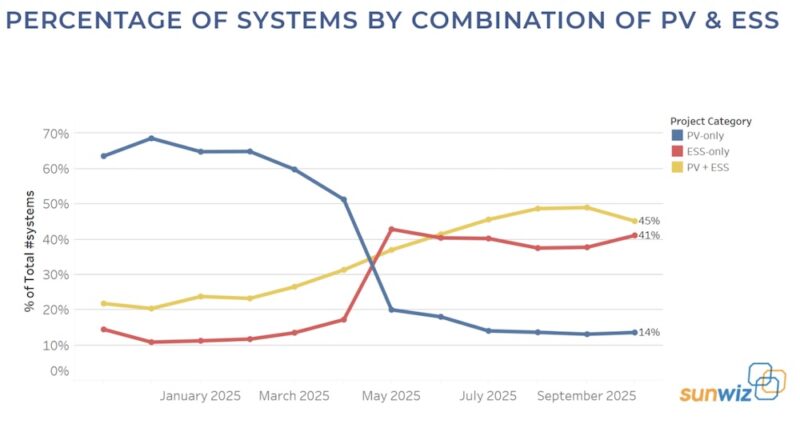
That said, the number of battery-only system installations continued to grow in October and still accounted for 41% of the total amount of Small-scale Technology Certificates created in the Small-scale Renewable Energy Scheme for the month.
As you can see in the chart above, PV only installations in October fell to just 14 per cent of registrations.

Sophie is editor of One Step Off The Grid and editor of its sister site, Renew Economy. Sophie has been writing about clean energy for more than a decade.