
• Skip to primary navigation
  • Skip to main content
  • Skip to primary sidebar
  • Skip to footer
One Step Off The Grid

One Step Off The Grid

Solar, storage and distributed energy news

  • Solar
  • Battery/Storage
  • Off-Grid
  • Efficiency
  • Software
  • Podcasts
  • Tariffs
  • Electric Vehicles
  • Electrification

Tesla Powerwall 3 submerged in fish tank still runs fridge, stovetop and coffee machine

May 9, 2024 by Sophie Vorrath Leave a Comment

When energy storage pioneer Tesla finally unveiled its Powerwall 3 home battery in September last year, the reception from the company’s adoring public amounted to a bit of a damp squib.

Sure the new Powerwall would be much more powerful than its predecessor – a 13.5 kWh unit capable of 11.5kW continuous on-grid power and 11.5kW continuous backup power – but it didn’t look as good and, in a classic Tesla twist, was quickly revealed to not be compatible with earlier Powerwall models or other solar inverters.

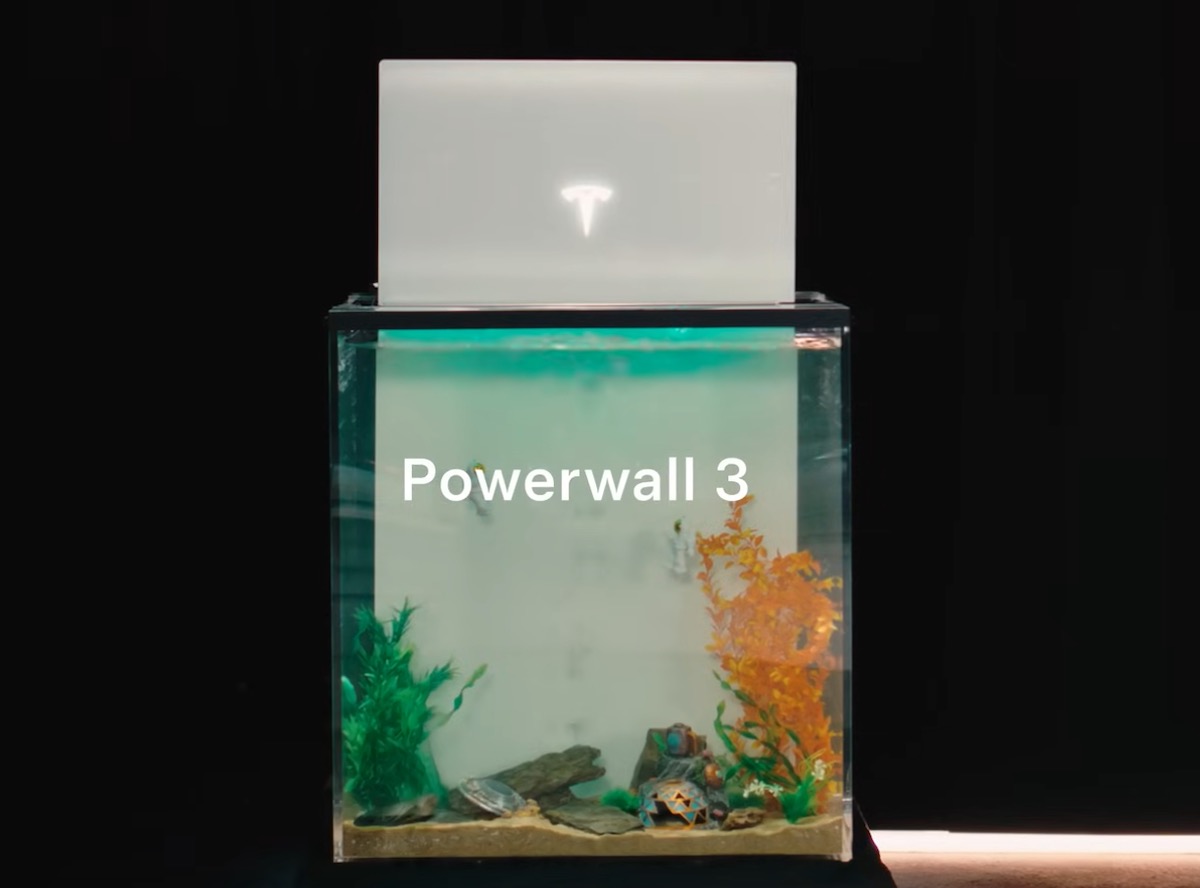
But did they know that the Powerwall 3 could still function while submerged in two feet of water?

A video recently published by Tesla on YouTube shows a Tesla Powerwall 3 sitting in a fish tank – live fish and water included – while continuing to provide enough power to run a fridge, an induction cooktop and a coffee machine.

“Powerwall 3 is designed to operate in extreme environments – including under water,” it says below the video.

“Watch Powerwall 3 operate a variety of high-energy appliances all at once while submerged in two feet of water.”

It’s a fascinating sales pitch that – keeping in mind Tesla unorthodox marketing and social media approach to business – surely falls firmly into the “don’t try this at home” category, but might offer some comfort to those living in flood prone areas.

Comments range from “this is awesome!”, to “my fish will love this,” and “My sunken ship was getting old, this new tank piece looks like a delight.”

Make of it what you will. But One Step notes that on the Tesla Australia website, it says that to optimise the battery’s performance, it “should not be installed in locations subject to flooding or near water sources such as downpipes or sprinkler systems.” We recommend you do NOT try this at home.

Sophie Vorrath
Sophie Vorrath

Sophie is editor of One Step Off The Grid and editor of its sister site, Renew Economy. Sophie has been writing about clean energy for more than a decade.

Filed Under: Battery/Storage

Primary Sidebar

Sign up for our weekly newsletter

Emissions Counter

Renew Economy

RSS Energy News from Renew Economy

  • Turbine blade breaks, falls to ground at wind farm damaged by lightning strike in 2019
  • Construction starts at state’s first “end-to-end” hydrogen and ammonia production plant
  • Angus Taylor’s energy policy is now a carbon copy of Hanson and Trump
  • Utility giant bets big on data centre demand with plans to build Australia’s biggest gas plant
  • Australia’s largest coal state to launch biggest tender yet for power delivered when the sun don’t shine

RSS Electric Vehicle News from The Driven

  • Mercedes-Benz says electric variants of its CLA compact sedan coming to Australia
  • Victoria signs global initiative to reach 100 pct zero-emission freight vehicles by 2040
  • Community group launches new neighbourhood battery, with EV charging bays
  • BYD’s biggest EV that’s not a bus approved for sale in Australia
  • Video: GAC AION V review – Still worth considering in 2026?

Press Releases

  • Huge luxury Saudi resort goes 100pct renewables with one of world’s biggest batteries
  • How solar + storage can be a game-changer for people with disabilities

Footer

Technologies

  • Solar
  • Battery/Storage
  • Electric Vehicles
  • Energy Efficiency
  • Software/Gadgets
  • Other Renewables
  • Policy
  • Tariffs
  • Contact
  • Advertise with us
  • About One Step Off The Grid
  • Terms of Use
  • Privacy Policy

Copyright © 2026 · OneStep Genesis on Genesis Framework · WordPress · Log in